One governed interface to the physical environment.
Build the connections between intelligence and physical space. Use ALYT’s rooms, capabilities, state, events and scoped controls instead of integrating every light, thermostat, sensor and vendor cloud separately.
// Server-side · npm i alyt-sdk
import { createAlyt } from "alyt-sdk";

const alyt = createAlyt({ appId, appSecret });
const { data, error } = await alyt.roomsList({
  query: { tenantId, propertyId }
});
// Inspect scoped rooms; handle errors before acting.
# Server-side · pip install alyt-sdk
from alyt_sdk import AuthenticatedClient
from alyt_sdk.api.rooms import rooms_list

# Use a token exchanged from your app credentials.
client = AuthenticatedClient(
    base_url="https://developers.alyt.com/api",
    token=ALYT_TOKEN,
)
rooms = rooms_list.sync(client=client,
    tenant_id=TENANT_ID, property_id=PROPERTY_ID)
curl "https://developers.alyt.com/api/v1/rooms?tenantId=$TENANT_ID&propertyId=$PROPERTY_ID" \
  -H "Authorization: Bearer $ALYT_TOKEN"
What you get
A published contract
Typed operations, summaries and responses generated from the services’ own route tables. Contract checks keep the API and SDKs aligned.
Two SDKs
TypeScript with no runtime dependencies and Python, both generated from the contract and versioned by its diff. One entry point: create a client with an app id and a secret.
A sandbox that is a real tenant
Its own property, seeded rooms and five virtual devices, with the same isolation, broker permissions and query narrowing as production.
Virtual devices on the real broker
Hub, speaker, light, sensor and thermostat profiles. Scenarios: offline, low battery, sensor error, burst, flapping, slow. The platform cannot tell them from hardware.
Signed webhooks and a stream
Deliveries signed with a timestamp and an HMAC, retries doubling to an hour, and a Server-Sent Events stream that resumes from the last id.
Submission and review
Draft, review, approval, publication. Automated checks, a probe against isolated credentials, then a human. Your connector reaches every home on release.
Events you can subscribe to
- device.online
- device.offline
- device.telemetry
- command.result
- notification.raised
- thing.state
- submission.state
- guest.invited
- guest.checked_in
- guest.checked_out
Scopes
- things:readread things and their state
- things:controlsend commands
- integrations:readread the catalogue
- events:readthe stream and webhooks
- webhooks:writemanage endpoints
- simulator:writevirtual devices
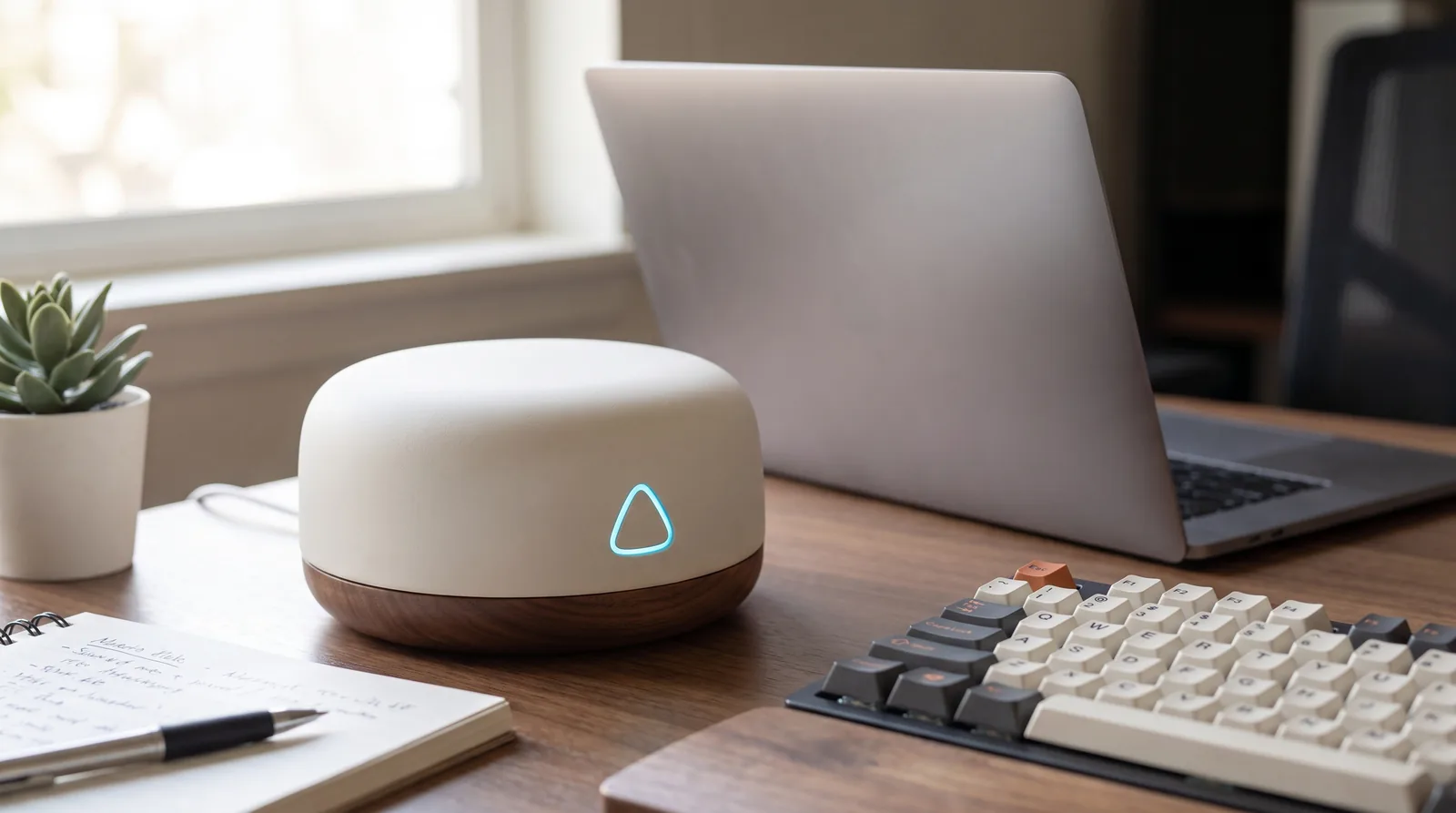
Your intelligence. The environment already in view.
AI agents, autonomous software and OEM intelligence can build against the public contract today. Test in an isolated sandbox. Richer agent context and future robotics interfaces are platform direction; ALYT keeps authority over state and physical execution.
Connectors normalize supported physical systems. Applications operate through scoped permissions. Inspect reported state and command outcomes: an acknowledgement is not proof that the physical action happened.
Public APIs, SDKs and supported events are available today. Richer environment views and agent proposals are in development; robots are a future client, not a deployed integration.
Make room for intelligence.
Bring your devices together. Give everyday routines a home. Meet ALYT.